
Topic 5 — Key Concepts in Participation
Participation isn’t just a buzzword or an abstract concert and value. In fact, it’s a set of tools, principles, and processes that empower citizens and strengthen democratic resilience. This section covers some core concepts and brings in examples of concrete participatory methodologies.
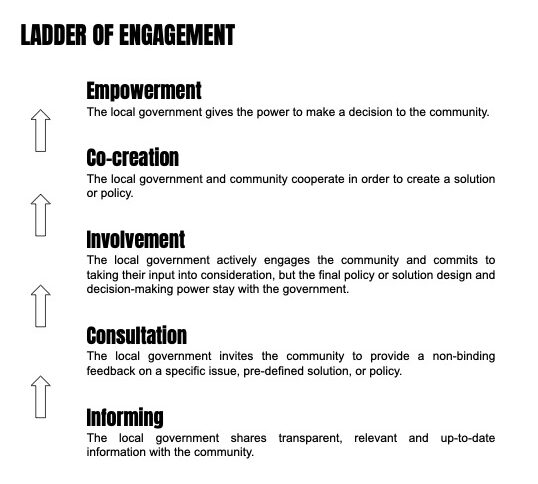
A. Ladder of Participation
Originally formulated by Sherry Arnstein (1969), the ladder shows levels of citizen participation from manipulation and tokenism to empowerment. Modern interpretations (OECD, Participation Factory) emphasize ethics, inclusivity, and measurable impact.
B. Deliberation
Deliberation is a structured process where citizens weigh evidence, discuss trade-offs, and reach considered judgments. It is not just talking but it is an informed, inclusive, and outcome-focused process of active listening and informed opinion sharing.
If done right, deliberation can help reduce polarization and build mutual understanding across social divides. It can also strengthen civic culture and trust in institutions.
C. Citizens’ Assemblies & Juries
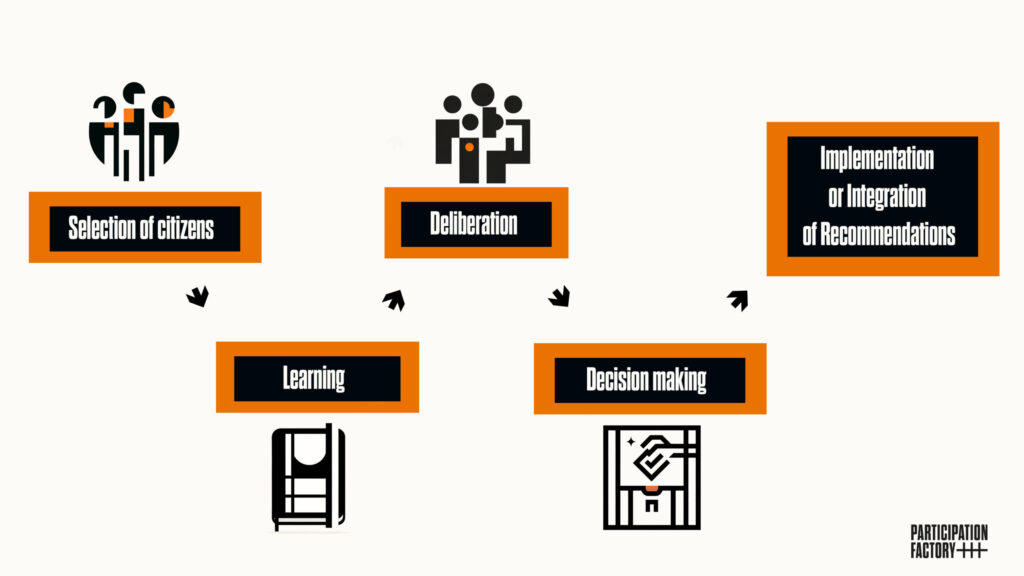
Citizens’ assemblies and juries use randomly selected, representative citizens to deliberate on policy questions. Participants are invited to go through a fact-based learning process with a diverse range of experts on a subject matter. Afterwards, they work in groups to deliberate and design answers or solutions to the posed questions. Lastly, all of the paricipatns are invited to share the outcomes of their work and vote on which ones should be selected to be presented to government officials and/or implemented.
This methodology aims to break down the elitism of representative democracy and self-selection bias as well as partisan polarization.
Lastly, Citizens’ Assemblies and Huries promote pluralistic and evidence-based policymaking and combat fake news, polarisation, and dis/misinformation.
D. Participatory Budgeting (PB)
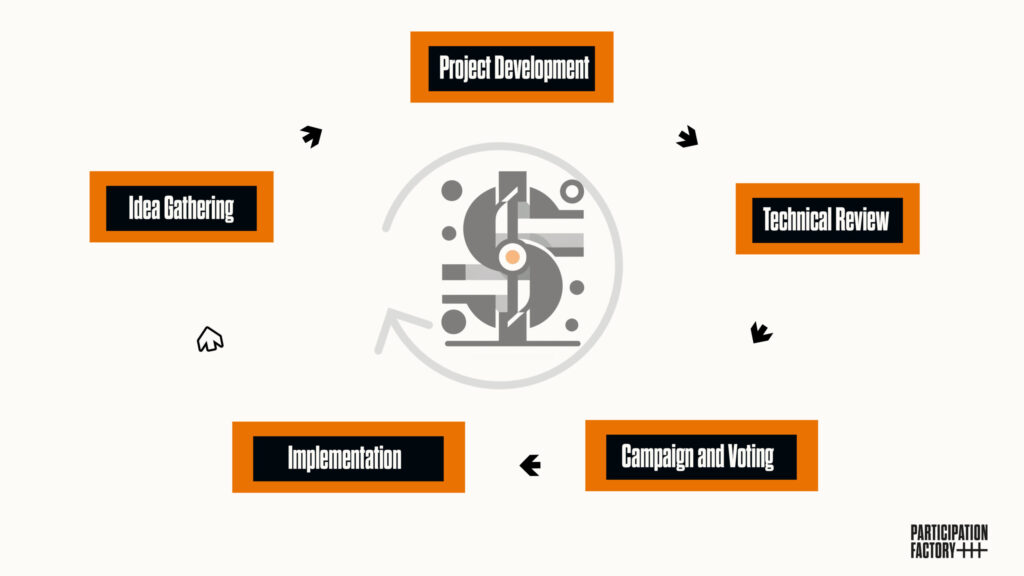
Participatory Budgeting (PB) is a process in which the public decides how to allocate part of a public budget through structured participation. The process involves idea gathering and shaping, technical assessment, campaigning, and voting.
PB started in Porto Alegre, Brazil, in 1989, as an anti-poverty measure that helped reduce child mortality by nearly 20%. Since then PB has spread to over 7,000 cities around the world.
In essence, PB combines decision-making, deliberation, and accountability in one process. It aims to redistribute power, create meaningful projects, and enhance transparency and public trust.
E. Participatory Planning & Policy Making
Participatory Planning and Policy-Making are co-creation and participatory planning processes that involve citizens directly in the design and implementation of policies, programs, and urban planning.
In essence, it implies the use of participatory methods in processes that focus on development of policies, plans, and programs, such as architectual competition, zoning plans etc.
It reduces centralized decision-making and allows for better solutions to be formed based on data coming directly from the stakeholders and the public.
F. Civic Tech
Civic Tech is short for civic technology. It stands for digital tools that enable participation, transparency, and civic engagement. Examples include apps that focus on voting for Participatory Budgeting or idea gathering for Public Policy-Making.
Use of Civic Tech lowers barriers to participation and allows scalable, continuous engagement especially for remote or dispersed communities. If set up correctly, it enhances transparency and accountability, reducing opportunities for autocratic manipulation.
However, participatory processes that rely solely on civi tech create unique barriers for engagement as they require participants to have internet conenctivity, hardware, and digital literacy and skills.
Resources:
https://www.peoplepowered.org/citizens-assemblies
https://www.peoplepowered.org/participatory-budgeting
https://www.participatorybudgeting.org/about-pb/#what-is-pb
https://www.oecd.org/en/topics/public-policymaking.html
https://www.peoplepowered.org/digital-participationhttps://www.oecd.org/content/dam/oecd/en/publications/reports/2025/04/tackling-civic-participation-challenges-with-emerging-technologies_bbe2a7f5/ec2ca9a2-en.pdf